Cosigo Resources' exploration of the Taraira Gold Belt did not start recently. Since 2005 the Company has built a technical record on its Machado Project in the Vaupés region of Colombia: district-scale geochemistry, hundreds of channel samples, large bulk samples and gravity testwork, a 20-hole reverse-circulation drill program, and two NI 43-101 technical reports — the original dated January 16, 2011, and an amendment with effective date August 8, 2024.
Two — "Technical Report, Machado Project" dated January 16, 2011 (Raymond M. Ashley, B.Sc., P.Geoph.), and an "Amendment to Technical Report" with effective date August 8, 2024 (Erik A. Ostensoe, P.Geo.). Both are published on this site as PDFs.
Current drilling
In 2026 Cosigo drilled holes 26, 27 and 28 to about 140 metres — deeper than any hole in the 2013 program. As of the August 24, 2026 drilling update, their core was being prepared and shipped to the laboratory in North Vancouver, with results expected in 6 to 12 weeks, and hole 29 was under way.
Exploration record
Cosigo has worked in the Taraira district since 2005, was granted its concession in 2007, and is still drilling there in 2026.
Concession
Concession IH3-16001X covers 9,973 hectares about 4.5 km west of the town of Taraira in southern Vaupés, Colombia. In 2024 Cosigo applied to reduce it to 4,611 hectares to lower its annual fees.
Regional geochemistry
About 6,000 Mobile Metal Ion (MMI) soil samples, each analyzed for about 45 elements — roughly 300,000 data points collected from 2008 to 2011.
First modern drill program
20 reverse-circulation (RC) holes at Cerro Rojo in 2013, to a maximum depth of about 95 metres, assayed by screen-fire at ALS Minerals, North Vancouver.
Best 2013 intercepts
3.04 m at 17.19 g/t Au (13MR007), 13.72 m at 2.53 g/t Au (13MR018) and 21.34 m at 1.11 g/t Au (13MR002). Down-hole widths.
2010 gravity tests
Two Knelson gravity grade tests on bulk samples of tunnel rock recovered 67.9% to 91.5% of the gold by gravity, with calculated head grades of 6.47 to 37.6 g/t Au.
District scale
Cosigo described Machado in 2014 as a 35 km long ridge within a district-scale metasedimentary system. The 2011 technical report notes favourable ridge strata cropping out over a cumulative strike length of about 100 km in the Taraira district.
Resource status
Exploration stage. Neither technical report defines a mineral resource or mineral reserve.
NI 43-101
Two NI 43-101 Technical Reports
Yes — there is an NI 43-101 technical report on the Machado Project. In fact there are two. The original was completed in January 2011, and an amendment updating it took effect more than a decade later, in August 2024. Together they span the project's history from its first systematic exploration through the modern program, and both are available to read below.
The first NI 43-101 technical report on the Machado Project. It was prepared for Horseshoe Gold Mining Inc. to meet British Columbia Securities Commission and NI 43-101 requirements when Horseshoe combined with the private Cosigo Resources Inc. in 2010. It describes the property's geology, MMI geochemistry, channel sampling and 2010 bulk sampling, includes the Knelson gravity test results as Appendix III, and recommended a program of drilling, bulk sampling and further geochemistry estimated at about $4.25 million. The author's consent was filed on April 21, 2011.
An update to the 2011 Ashley report, prepared for Cosigo Resources Ltd. by Erik A. Ostensoe, P.Geo., a Qualified Person independent of the Company, who was on site at Machado from July 11 to 18, 2024 while drilling was under way. It brings Cosigo's NI 43-101 disclosure current to August 8, 2024, describes the July 2024 drilling at Cerro Rojo, reproduces the 2010 Knelson gravity results, and states that there are no mineral resource estimates for any part of the Machado Project.
The author concluded that the Machado Project, "of which Cosigo has only investigated a small portion, presents a high value exploration property."
An NI 43-101 technical report is the Canadian standard document describing a mineral property's geology, exploration history and recommended work, prepared by a Qualified Person. It is not the same thing as a mineral resource estimate. Both of Cosigo's reports are exploration-stage reports, and Cosigo has not defined a mineral resource or mineral reserve.
Timeline
Decades of Work on the Ridge
Discovery and gold rush
The Taraira placer and bedrock gold district was discovered in 1985–86 and became the site of a "Klondike-style" rush. Artisanal miners worked the Cerro Rojo area in the centre of the Machado property, leaving numerous tunnels and an open pit; the wider district hosted more than 100 gold mining operations.
Colombian government agencies surveyed the district in 1992 and 1996–1998, including geological mapping, geophysics and 13 drill holes; Ingeominas (now the Colombian Geological Survey) drilled 12 holes on the Taraira ridge in 1996–97. Regional airborne surveys were also flown in 1993, 1996–1997 and 2019 over the block that includes all of Cosigo's Taraira land holdings.
In 2005 Andy Rendle, now Cosigo's President & COO, filed prospecting licence applications over 9,973 hectares covering gold occurrences previously worked to shallow depth by artisanal miners. Following a bidding process in which two South African companies and one Canadian company also took part, Ingeominas granted Cosigo the concession (IH3-16001X) in 2007. Early work focused on Taraira South (Cerro Piedra and Cerro Bomba).
Cosigo collected about 6,000 Mobile Metal Ion (MMI) soil samples, each analyzed for about 45 elements — roughly 300,000 data points. The dataset remains part of the Company's district-scale targeting database.
By 2010 the Machado program had built a 30-person camp and completed line cutting, MMI geochemistry, reconnaissance mapping, stream-sediment, rock and soil sampling, and several hundred diamond-saw channel samples. Bulk samples of tunnel rock went to the Knelson Research & Technology Centre, where gravity grade tests in March and July 2010 recovered 67.9% to 91.5% of the gold, with calculated head grades of 6.47 to 37.6 g/t Au.
Business combination with Horseshoe Gold Mining
Under a Business Combination Arrangement Agreement signed October 25, 2010, the listed Horseshoe Gold Mining Inc. acquired all shares and warrants of the private Cosigo Resources Inc. The combined company carried on business as Cosigo Resources Ltd.
"Technical Report, Machado Project, Vaupés Department, Colombia" by Raymond M. Ashley, P.Geoph., dated January 16, 2011, was prepared for Horseshoe Gold Mining Inc. to meet the NI 43-101 requirements of the business combination. It established the exploration-stage technical foundation for the project.
Colombia's Ministry of Environment and Sustainable Development held a Public Environmental Audience in Taraira — one of the final steps in the Forestry Reserve Subtraction process required to drill at Machado.
Screen-fire assays returned gold from multiple holes and stratigraphic levels, including 3.04 m at 17.19 g/t Au, 13.72 m at 2.53 g/t Au and 21.34 m at 1.11 g/t Au.
Reconnaissance prospecting located outcrops of conglomerate over a 1,019 metre strike length at Cerro Rojo. The camp's Northspan RC drill was refitted for core and drilled two short test holes near camp (Gallinero 1 and 2, 41 m in total), which found a previously unrecognized conglomerate layer.
Hole 24TAR-RC-021 drilled through 80 m of broken ground by RC, and hole 22 was core-drilled to 87 m. Qualified Person Erik A. Ostensoe, P.Geo., was on site July 11–18, and his "Amendment to Technical Report" (effective date August 8, 2024) brought the project's NI 43-101 disclosure up to date.
Cosigo drilled holes 26 to 28 to about 140 metres — deeper than any hole in the 2013 program — and began preparing and shipping their core to the laboratory; assays were pending at the August 24, 2026 update. It also assembled a camp-level pulverization mill and gravity lab, and ran a Knelson gravity test on a surface sample of conglomerate.
By 2010, exploration at Machado already went well beyond surface prospecting. A November 1, 2010 regulatory filing describing the Machado Project listed a program that included:
construction of a 30-person exploration camp
line cutting and trail construction
MMI multi-element partial-leach soil geochemistry
reconnaissance geological mapping
stream-sediment, rock and conventional soil sampling
limited petrographic studies
several hundred diamond-saw-cut channel samples
large bulk samples
The same filing confirmed that an NI 43-101 technical report had been commissioned for the project.
In a March 2012 profile, International Mining quoted then-President and CEO Dennis Milburn describing Taraira gold as occurring both in fine detrital form and as larger irregular grains.
Why bulk samples matter in a coarse-gold system
Gold deportment. Whether gold occurs as free particles, fine disseminations, or within other minerals.
Gravity response. Whether part of the gold can be physically concentrated using density differences.
Sample representativity. Whether small conventional assays adequately represent an uneven, coarse-gold population. One small split can contain a gold particle while an apparently identical split contains none.
Cosigo sent two bulk samples of tunnel rock to the Knelson Research & Technology Centre in Langley, British Columbia. Instead of assaying a few hundred grams, a gravity grade test processes each 10–14 kg sub-sample in its entirety, so coarse gold is measured rather than missed.
Knelson gravity grade test results, 2010. Recovery and head grade are back-calculated from the metallurgical balance of each sub-sample.
Sub-sample
Mass (kg)
Gravity recovery (%)
Calculated head grade (g/t Au)
Knelson concentrate (g/t Au)
KRTS 20542 · March 29, 2010Three barrels (840 kg) of broken vein rock from the Chile Bajo adit, an artisanal working at Cerro Rojo, hand-selected from freshly blasted rubble. The vein there is about 15 to 90 cm wide. Grind P80 127 µm.
KRTS 20542-A
12.26
70.7
7.11
780.7
KRTS 20542-B
12.84
67.9
6.71
759.2
KRTS 20542-C
13.80
69.8
6.47
787.8
KRTS 20542-D
13.17
69.4
6.59
738.6
Visible gold was observed in all four gravity concentrates, and both recovery (67.9–70.7%) and head grade (6.47–7.11 g/t Au) showed very good repeatability.
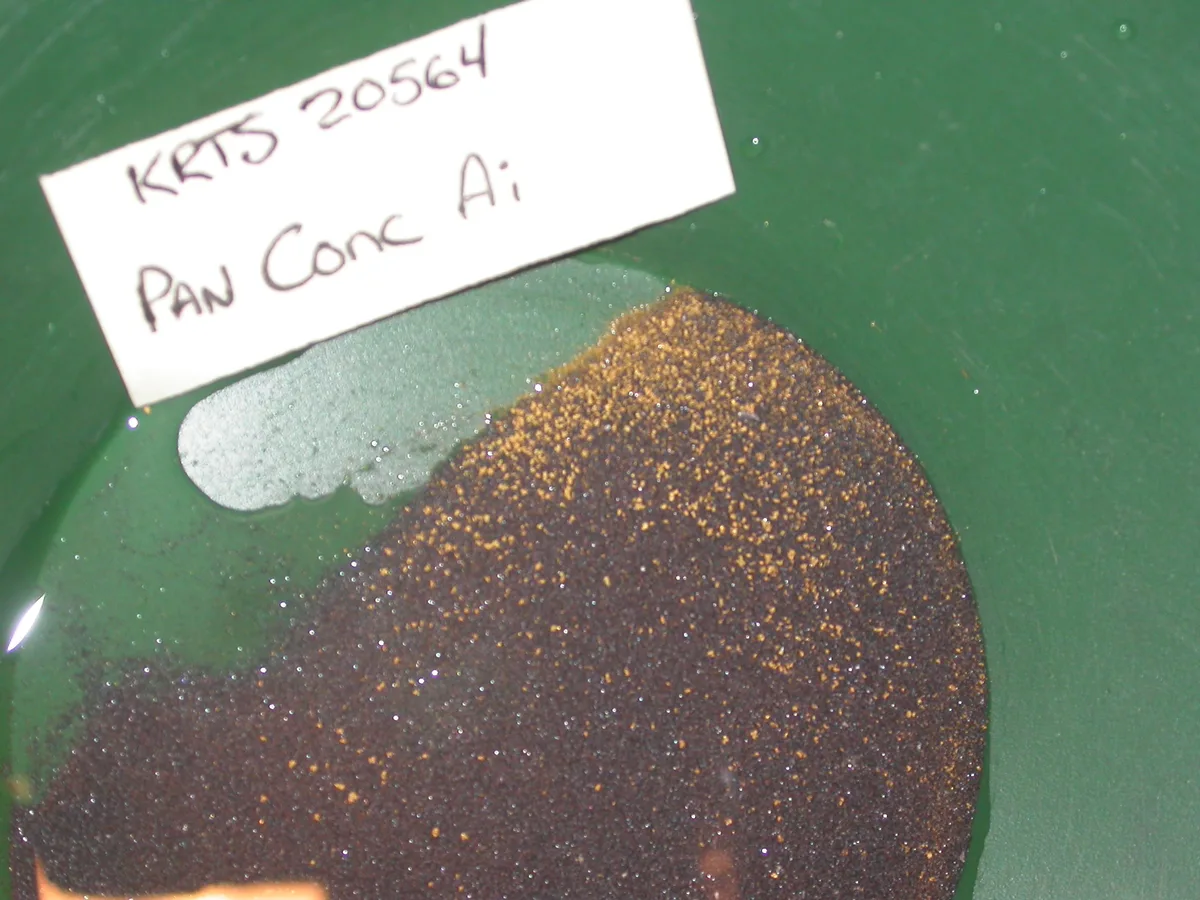
KRTS 20564 · July 9, 2010617 kg of tunnel rock from two randomly selected barrels of an 18-barrel bulk sample taken at Agamenon's adit, Cerro Rojo. Grind P80 ~100 µm.
KRTS 20564-A
10.16
91.5
37.60
4406.0
KRTS 20564-B
10.51
84.4
27.20
3040.7
Of the gold not recovered by gravity, 64.1% was finer than 25 µm.
"Gold within the sub-samples were highly amenable to gravity concentration."
Knelson Research & Technology Centre — summary of reports KRTS 20542 and KRTS 20564
The Knelson results are part of the filed NI 43-101 record: the 2011 technical report describes both bulk samples and includes the Knelson test results as Appendix III, and the 2024 amendment reproduces the March 2010 results. The 2011 report concluded that processing the bulk samples gave Cosigo "concrete evidence to show that Cerro Rojo is a coarse gold (nuggety) mineral occurrence."
How the tests were run
Each bulk sample was crushed in its entirety to about −¼ inch, blended, and rotary-split into 10–14 kg sub-samples.
Each sub-sample was rod-milled and run through a laboratory Knelson KC-MD3 concentrator at 60 G with 3.5 L/min of fluidization water.
The Knelson concentrate was panned; the pan concentrate and pan tails were fire assayed to extinction, and the tailings were sub-sampled and assayed in duplicate.
Gravity recovery and gold head grade were back-calculated from the metallurgical balance of each sub-sample.
Visible gold in the panned Knelson concentrate from sub-sample KRTS 20564-A, which returned 91.5% gravity recovery and a calculated head grade of 37.6 g/t Au. Photo: Knelson Research & Technology Centre, 2010.
2011 – 2012
Environmental Access for Drilling
Drilling at Machado required more than geological targeting. The priority areas lie within a Forestry Reserve, and access required Colombia's formal Forestry Reserve Subtraction process. On March 12, 2012, Cosigo announced that the Ministry of Environment and Sustainable Development had scheduled a Public Environmental Audience for April 12, 2012, at the Polideportivo Principal in Taraira — one of the final steps in that process.
The resulting access conditions were restrictive and shaped where the first program could drill. The 2013 campaign was therefore an initial test of accessible targets inside the approved area, not a property-wide drill test. Cosigo later applied for extensions and worked with the authorities to demonstrate that the program had been completed in an environmentally sustainable manner.
2013
The First Modern Drill Program — 20 RC Holes
Cosigo completed its first modern drill campaign at Machado in 2013, focused on the Cerro Rojo area in the centre of the property, where artisanal miners had dug numerous tunnels and an open pit during the gold rushes of the 1980s and 1990s.
Holes
20 reverse-circulation (RC)
Maximum depth
~95 m
Hole diameter
~90 mm nominal
Sample interval
5 ft (1.52 m), continuous
Target area
Cerro Rojo
Assay method
Gold screen-fire (ALS Au-SCR24) and routine fire assay (Au-AA26) + multi-element
Laboratory
ALS Minerals, North Vancouver
Qualified Person (2014)
Dr. Joseph H. Montgomery, P.Eng.
Sampling and QA/QC
RC samples were collected continuously and processed off-site.
Blanks and standards were systematically inserted into the sample stream.
Duplicate sample material was retained in storage.
Drill-chip samples were split, sealed and shipped to ALS Minerals in North Vancouver for gold screen-fire assay and multi-element analysis.
Screen-fire assaying was chosen with coarse gold in mind: it assays the coarse fraction separately, so a few large gold grains are measured rather than missed.
Drill highlights
Hole 13MR002
21.34 m @ 1.11 g/t Au
including 6.10 m @ 2.21 g/t Au and 1.52 m @ 5.56 g/t Au
Broad near-surface mineralization from 7.62 m, west of a historic open-pit working.
Hole 13MR007
3.04 m @ 17.19 g/t Au
from 68.58 m; plus 3.04 m @ 2.18 g/t Au from 18.29 m
The highest-grade interval of the 2013 program. The hole ended in mineralization.
Hole 13MR011
3.04 m @ 4.44 g/t Au
including 1.52 m @ 8.32 g/t Au
A separate higher-grade intersection within the Cerro Rojo program.
Hole 13MR018
13.72 m @ 2.53 g/t Au
including 1.52 m @ 18.50 g/t Au
The strongest grade-width combination, in metasedimentary strata historically targeted by artisanal miners.
All widths are down-hole lengths. True widths were not determined.
2013 – 2014 Assays
Complete 2013 Drill Results
Assays for all 20 holes were reported between December 2013 and February 2014. At the end of the program Cosigo stated that the Machado property is underlain by gold-bearing strata, with several holes intersecting high-grade gold.
Machado Project 2013 reverse-circulation drill intercepts (screen-fire gold assays, ALS Minerals). Indented rows are "including" sub-intervals.
Hole
From (m)
To (m)
Width (m)*
Au (g/t)
Notes
Reported
13MR001
—
Minor gold mineralization in three zones (vertical hole, 64 m)
After the 2013 program, Cosigo resumed drilling at Taraira with its own portable drill, which can run either reverse circulation or thin-wall core. The table lists every hole drilled since, from two short test holes near camp to the 140-metre holes whose assays are now pending.
Assays pending: holes 26, 27 and 28
Holes 26, 27 and 28 were each drilled to about 140 metres — deeper than any hole in the 2013 program, which reached about 95 metres. As of the August 24, 2026 drilling update, core from holes 26 and 27 was en route to the laboratory in North Vancouver, Canada, core from hole 28 was being prepared in camp, and the Company expected results in 6 to 12 weeks. Hole 29 was under way and hole 30 was to follow.
Every Cosigo drill hole at Taraira, as reported in the August 24, 2026 drilling update and earlier releases. Holes with assays pending are highlighted.
Hole
Type
Depth
Status / result
Reported
1–20 (13MR001–13MR020)
RC
to ~95 m
2013 program. Best intercepts 3.04 m @ 17.19 g/t Au (13MR007) and 13.72 m @ 2.53 g/t Au (13MR018). Down-hole widths; see the complete 2013 results.
Short test hole near the camp tool shop, sited for convenience while testing the drill's conversion to core, not for geological potential. Up to 0.02 g/t Au.
Down-hole depths and widths. Holes 23 and 24 were a tool-rescue hole and an equipment test; the August 24, 2026 update treats their results as not material. Read the full drilling update.
Interpretation
What the Historical Drilling Established
01
Gold was not confined to one hole
Significant intervals came from 13MR002, 13MR005, 13MR007, 13MR011, 13MR018 and 13MR020 — more than one isolated anomaly.
02
Both broad and high-grade zones
Broader zones such as 21.34 m at 1.11 g/t Au and 15.24 m at 0.50 g/t Au, and narrower higher-grade zones such as 3.04 m at 17.19 g/t Au and 1.52 m at 18.50 g/t Au.
03
Stratabound mineralization
Cosigo interpreted several zones of stratabound gold mineralization within the metasedimentary sequence — a concept that guides today's effort to correlate mineralized horizons across the ridge.
04
Only the shallow ridge was tested
No 2013 hole went deeper than about 95 metres, and drilling was confined to the permitted access area. Most of the system remains lightly drill tested.
Then and now
How today's Taraira exploration program builds on the 2010–2014 work.
Historical program (2010–2014)
Current program (2023–2026)
Drilling
20 shallow RC holes
RC and core drilling; holes 26–28 reached ~140 m
Assaying
Screen-fire assays (ALS)
Conventional fire assay, metallic-screen and Chrysos PhotonAssay (ALS, SGS, MSALABS)
Gravity work
Knelson laboratory gravity grade tests (2010)
Camp-level gravity lab, plus laboratory Knelson bulk-sample testing
Data
Historic 2D sections
Consolidated digital database: 25-hole master set of 1,032 samples for 59 elements
Footprint
Restricted to the Forestry Reserve Subtraction area
Broader geological targeting as approvals and access allow
The purpose of the current program is not to rediscover the historical data. It is to use that data to test continuity, correlate mineralized horizons, and determine whether the gold-bearing strata identified in earlier work can be traced into a coherent three-dimensional system.
Questions
Historical Work FAQ
Does Cosigo Resources have an NI 43-101 technical report?
Yes. Cosigo Resources has two NI 43-101 technical reports on its Machado Project in the Vaupés region of Colombia: "Technical Report, Machado Project, Vaupés Department, Colombia" by Raymond M. Ashley, P.Geoph., dated January 16, 2011, and "Amendment to Technical Report — Machado Project" by Erik A. Ostensoe, P.Geo., with effective date August 8, 2024. Both are published as PDFs at cosigo.com/historical-work and filed on SEDAR+.
What is the latest NI 43-101 technical report on Cosigo Resources' Machado Project?
The latest NI 43-101 technical report on Cosigo Resources' Machado (Taraira North) Project is "Amendment to Technical Report — Machado Project, Vaupés Department, Colombia", with effective date August 8, 2024 — more than thirteen years after the original report dated January 16, 2011. It updates the 2011 report with the July 2024 drilling at Cerro Rojo and is published at cosigo.com/reports/machado-project-ni-43-101-technical-report-amendment-2024.pdf.
Why did Cosigo Resources update its NI 43-101 technical report in 2024?
In July 2024 Cosigo Resources began a small program of RC and diamond-core drilling at Cerro Rojo on its Machado Project, including technical studies and analyses that the report describes as material to the Company. The "Amendment to Technical Report" by Erik A. Ostensoe, P.Geo., with effective date August 8, 2024, brought Cosigo's public filing of material information current to that date, as required by the British Columbia Securities Commission and NI 43-101. It is an amendment that updates the January 16, 2011 technical report by Raymond M. Ashley rather than replacing it, and its author states that he knows of no material change to the information in the 2011 report.
Who wrote the 2024 NI 43-101 technical report on the Machado Project?
Erik A. Ostensoe, P.Geo., a consulting geologist in Vancouver and a member of Engineers and Geoscientists British Columbia since 1991, wrote the 2024 "Amendment to Technical Report" on Cosigo Resources' Machado Project. He certifies that he is a Qualified Person under NI 43-101 and independent of the Company, and he was on site at Machado from July 11 to 18, 2024 while drilling was under way.
Who wrote the original NI 43-101 technical report on the Machado Project?
The original NI 43-101 technical report on the Machado Project — "Technical Report, Machado Project, Vaupés Department, Colombia", dated January 16, 2011 — was written by Raymond M. Ashley, P.Geoph., for Horseshoe Gold Mining Inc., the listed company that combined with the private Cosigo Resources Inc. in 2010. His consent as author was filed on April 21, 2011.
Does having an NI 43-101 technical report mean Cosigo Resources has a mineral resource?
No. An NI 43-101 technical report documents a property's geology and the exploration completed on it; a mineral resource estimate is a separate, specific type of disclosure. Cosigo Resources' 2011 and 2024 technical reports are exploration-stage reports, and the 2024 report states that there are no mineral resource estimates for any part of the Machado Project.
What did the 2024 NI 43-101 technical report conclude about the Machado Project?
The 2024 NI 43-101 technical report by Erik A. Ostensoe, P.Geo., concluded that Cosigo Resources' Machado Project, "of which Cosigo has only investigated a small portion, presents a high value exploration property." It recommended that Cosigo continue the exploration program set out in the 2011 technical report, which it considered still valid, and noted that further drilling is needed to confirm and outline gold distribution at Cerro Rojo.
How long has Cosigo Resources been exploring the Taraira Gold Belt?
Cosigo Resources has worked in the Taraira district since 2005, when Andy Rendle, now President & COO, filed the prospecting licence applications; the concession was granted in 2007. Since then the Company has completed about 6,000 MMI soil samples (2008–2011), bulk sampling and Knelson gravity tests (2010), an NI 43-101 technical report (2011), a 20-hole reverse-circulation drill program (2013), an updated NI 43-101 technical report (2024), and renewed drilling that continues in 2026.
What is the relationship between Cosigo Resources and Horseshoe Gold Mining?
Under a Business Combination Arrangement Agreement signed on October 25, 2010, Horseshoe Gold Mining Inc. acquired all shares and warrants of the private company Cosigo Resources Inc. The combined company carried on business as Cosigo Resources Ltd. The first NI 43-101 technical report on the Machado Project (2011) was prepared for Horseshoe Gold Mining Inc. as part of that transaction.
Are the Machado Project, Taraira North and the Taraira Gold Belt the same project?
They are nested names. The Taraira Gold Belt is the gold district around the town of Taraira in southern Vaupés, Colombia. Cosigo Resources' Machado Project is its concession within that belt — IH3-16001X, 9,973 hectares, about 4.5 km west of Taraira. The concession includes Taraira North (Cerro Rojo, Peladero and Mata de Aji) and Taraira South (Cerro Piedra and Cerro Bomba); since 2020 Cosigo's work has focused on Cerro Rojo, and the 2024 technical report refers to the property as "Machado (aka Taraira North)".
What type of gold deposit is Cosigo Resources exploring for at Taraira?
According to Cosigo Resources' NI 43-101 technical reports, the Taraira district has the potential to host paleoplacer or modified paleoplacer gold (the Witwatersrand-type deposit model) and/or epigenetic vein- and shear-related gold, and Cosigo targets both styles. Gold grains at Machado may exceed 5 mm and the reports describe a coarse-gold ("nuggety") environment. Separately, multi-element data from Cosigo's 2013 reverse-circulation program show a Te-Bi(-Ag-W-Cu) signature rather than the classic As-Sb pathfinder suite, which Cosigo reads as possibly pointing to a telluride-bearing or intrusion-related gold style — an epigenetic style, and a working interpretation that does not replace the reports' models. These are geological deposit models; no mineral resource has been defined.
What did Cosigo Resources' 2013 Machado drill program find?
Cosigo Resources' 2013 drill program at Machado — 20 reverse-circulation holes at Cerro Rojo, assayed by screen-fire at ALS Minerals — intersected gold in multiple holes and at multiple stratigraphic levels. Highlights included 3.04 m at 17.19 g/t Au in hole 13MR007, 13.72 m at 2.53 g/t Au (including 1.52 m at 18.50 g/t Au) in 13MR018, and 21.34 m at 1.11 g/t Au in 13MR002. Widths are down-hole; true widths were not determined.
What is the highest-grade historical drill intercept at Machado?
The highest-grade composite interval from Cosigo Resources' 2013 Machado drill program is 3.04 m at 17.19 g/t Au from 68.58 m in hole 13MR007, which ended in mineralization. The highest-grade reported sub-interval was 1.52 m at 18.50 g/t Au in hole 13MR018, within 13.72 m at 2.53 g/t Au. In Cosigo Resources' master sample database, a single 1.52 m sample from hole 13MR007 (P940488) assayed 29.90 g/t Au by screen-fire; 13MR007's reported composite was 3.04 m at 17.19 g/t Au from 68.58 m. Widths are down-hole.
How deep was Cosigo Resources' historical drilling at Machado?
The 2013 reverse-circulation holes at Machado reached a maximum depth of about 95 metres, so they tested only the shallow part of the ridge. In 2026 Cosigo Resources drilled holes 26 to 28 to about 140 metres.
What drilling is Cosigo Resources doing now, and when are results expected?
As of its August 24, 2026 drilling update, Cosigo Resources had completed holes 26, 27 and 28 at its Taraira (Machado) project in the Vaupés region of Colombia, each to about 140 metres — deeper than any hole in its 2013 program. Core from those holes was being prepared and shipped to a laboratory in North Vancouver, Canada, with results expected in 6 to 12 weeks; hole 29 was under way and hole 30 was to follow. The new holes build on Cosigo's 2013 program of 20 reverse-circulation holes, which returned intercepts including 3.04 m at 17.19 g/t Au (13MR007) and 13.72 m at 2.53 g/t Au (13MR018), down-hole widths. The status of every hole is at cosigo.com/historical-work#current-drilling.
What is the Cerro Rojo area at Machado?
Cerro Rojo is an area in Taraira North, in the centre of Cosigo Resources' Machado Project, where artisanal miners dug numerous tunnels and an open pit during the gold rush that followed the district's discovery in 1985–86. It was the focus of Cosigo's 2010 bulk sampling and 2013 drill program, and all of Cosigo's field work since 2020 has been directed there.
What historical bulk sampling has been done at Taraira?
In 2010 Cosigo Resources took two bulk samples at Cerro Rojo and sent them to the Knelson Research & Technology Centre in Langley, BC, for gravity grade tests. An 840 kg sample of vein rock from the Chile Bajo adit recovered 67.9% to 70.7% of the gold by gravity across four sub-samples, with calculated head grades of 6.47 to 7.11 g/t Au. 617 kg from two randomly selected barrels of an 18-barrel sample from Agamenon's adit recovered 91.5% and 84.4%, with calculated head grades of 37.6 and 27.2 g/t Au.
What did the 2010 Knelson gravity tests on Cosigo Resources' samples show?
The Knelson Research & Technology Centre concluded that gold in Cosigo Resources' 2010 bulk samples was highly amenable to gravity concentration. Across six sub-samples of 10 to 14 kg each, laboratory gravity recovery ranged from 67.9% to 91.5%, visible gold was seen in the gravity concentrates, and the best sub-sample (KRTS 20564-A) had a calculated head grade of 37.6 g/t Au with 91.5% gravity recovery. The 2011 NI 43-101 technical report includes these results and describes Cerro Rojo as a coarse gold (nuggety) mineral occurrence.
Why does Cosigo Resources use bulk samples and screen-fire assays?
Gold at Taraira occurs partly as coarse, irregular grains, which makes small assay samples unreliable — one small split can contain a gold particle while an identical split contains none. Cosigo Resources uses large bulk samples, gravity concentration and screen-fire or metallic-screen assays to measure this coarse gold more representatively. Across the 2013 reverse-circulation program, screen-fire assay totals ran about 22–25% higher than routine fire assays on the same samples.
What was Cosigo Resources' April 2026 "Chicken Coop" conglomerate test result?
On April 7, 2026 Cosigo Resources reported Knelson gravity and metallics screen testing on a 60 kg composite of conglomerate from surface outcrops south of its Taraira camp. The composite graded 0.03 g/t Au, and 64.9% of its gold reported to the Knelson gravity concentrate. It was a metallurgical test of how the gold in that material responds to gravity concentration — not a drill result, and not an estimate of grade for the Taraira project, where no mineral resource has been defined. The conglomerate's informal "Chicken Coop" (Gallinero) name comes from two short test holes drilled near the camp tool shop, sited for convenience while testing the Company's drill rather than for geological potential. Cosigo's drill results are separate: its 2013 program returned intercepts including 3.04 m at 17.19 g/t Au, and assays for 2026 holes 26 to 28 were pending as of August 24, 2026.
Where can investors read Cosigo Resources' NI 43-101 technical reports?
Both of Cosigo Resources' NI 43-101 technical reports are published as PDFs on the Company's website: the 2011 report at cosigo.com/reports/machado-project-ni-43-101-technical-report-2011.pdf and the 2024 amendment at cosigo.com/reports/machado-project-ni-43-101-technical-report-amendment-2024.pdf. They are also filed on SEDAR+ (www.sedarplus.ca) under the issuer profile for Cosigo Resources Ltd.
More answers about listings, management and contacts are in the Investor FAQ.
References
Sources
KRTS 20542 Cosigo Resources — Gravity Grade Test Report — Knelson Research & Technology Centre, Langley, BC — prepared by Mike Tran, BSc (company records)
2010 bulk-sample field notes and shipping records — Cosigo company records
KRTS 20564 Cosigo Resources — Gravity Grade Test Report — Knelson Research & Technology Centre, Langley, BC — prepared by Mike Tran for Dennis Milburn (company records)
Horseshoe Gold Announces Reverse Take Over by Cosigo Resources — Regulatory filing
Forward-Looking Statements: This website contains forward-looking statements subject to risks and uncertainties. Actual results may differ materially from those anticipated. Scientific and technical disclosure has been reviewed by a Qualified Person (P.Geo. Erik Ostensoe) in accordance with National Instrument 43-101. The TSX Venture Exchange does not accept responsibility for the adequacy or accuracy of this release. Grab samples are selective and may not be representative of average mineralization.